




 |  |  |  |  |  |  |



 | | |  | | | |
| |||
Which 3D software package should you learn to animate in? - 7th of Dec 2007I'd love to come storming in here with my old tried and tested line of... it doesn't matter which package you learn. But that was in the days when there were so many 2D people converting to 3D that a lot of companies took it for granted that they would most likely have to train you in their choice of software anyway. These days there are so many fresh 3D graduates applying that most companies have the luxury of choice for whatever their package is and they can forget the rest. Sounds harsh, but it means that you have to be unbelievably good (not going to happen straight out of education 99.9999% of the time) or you have to have learned on the software that will most likely be used in the first studio you work in. So look around, decide for yourself. XSI: If you choose XSI you'll be highly valued in the small number of studios that use it so far. That will change. But there won’t be a great many opportunities at entry level companies. AM: If you choose Hash Animation Master you'd better be good, because it's doubtful that anywhere you apply uses it (I'm not knocking it I own a copy and can attest to it's virtues). Use it if you’re learning off your own back and have to buy it yourself, but if you’re at University, chances are you’ll have more expensive packages to choose from. Lightwave: If you choose Lightwave you're in a similar position to XSI except further down the scale, so perhaps a better chance of employment prospects early on. Max: If you choose Max you’ll have a huge number of games companies to apply to which is where a large percentage of animators start their careers. Some budget non-games companies use it, but usually because their founders came from the games industry. It’s also used in various non-entertainment related companies. Maya: If you Choose Maya, you’ll be more marketable to a higher end of the production scale, but there will be fewer entry-level studios using it because it used to be quite expensive. It’s certainly the best supported package, because most people want to work in the feature industry and it’s used expensively there. So students learn in it and support it. I started in 3D Studio 4… in DOS, and transitioned to Max. But I have used all of them at one point or another and personally I choose Maya to animate in although I can certainly see the value of XSI & AM and I only stick to Maya out of comfort because I’ve been using it for so long. That brings me to another very important point. I used to be a 2D animator and the thought of losing my hands and learning to animate with a piece of chalk in between my toes would just cripple my creativity. That’s exactly what I’ve had to do every time I’ve learned another piece of software! It’s a pet peeve and I really don’t like learning new software if I can help it, as I know that I can achieve so many new and wonderful things with the tools I already know. I’d rather spend my time developing my animation, design, filmmaking and character skills than worrying about different ways to do the same thing with different buttons. So in conclusion, if you don’t want to spend your life relearning how to do the basics find the right one for you and then use it 150% beyond it’s capabilities to expand your creative horizons. That’s what I try to do!
| |||
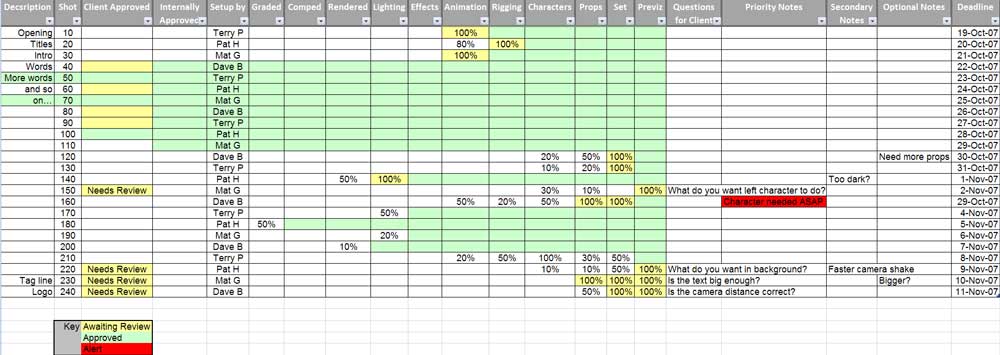
Using an Animation Production Tracker - 30th of Oct 2007If you're developing an animated project more than half a dozen shots long you should always use some sort of production tracker. They goes by many names and come in many forms but if you don't use one at all, and you don't maintain it, you're wasting large portions of your resources and time. Many people moan about doing this sort of 'paper work', but it pays for itself many times over once you get used to it. If your project isn't too complicated and you don't have specialist expertise to track the production then a simple spread sheet will do the job. It doesn't have to be filled with maths, it just has to be organized and clearly laid out, that's why a table of some sort works well. I've made up a dummy Animation Production Tracker here for you to look at, just to give you an idea of one in it's simplest form. It's really not that complicated and you can see at a glance how far the production has progressed and where it's floundering. It's so simple to update anyone on the team can do it, and yet it shocks me how often projects have been allowed to wallow aimlessly without anything like this in place. So don't risk it, learn from this simple tracker… experience it's benefits and progress to greatness from there!
| |||
More Communication in Animation - 29th of Oct 2007Put simply, I have wasted a large percentage of my career (lets just say more than 75% to be kind) on projects that lack sufficient communication and asset management. It's one of the main reasons I've had to slip into a semi management role myself to fill the inevitable gaps. I look back now and realize that I've spent most of my time waiting for other people to do their part, then finally being rushed to do my part (usually incurring unpaid overtime). What's worse is that when you are rushed quality goes out of the window. I usually do my best to pre-empt problems before it gets to my part, this helps. But this usually has the effect of building up the expectations of the final product, only to have them all dashed as the time limit crushes the quality. The solution for all of this? Communicate more effectively at every stage, don't wait weeks or months or years to talk to the client about an important issue. Show progress regularly and with everyone that needs to see it. Be open about offering criticism and open to receiving it. Make sure that the communication is effective, use images, emails, telephones, webcams, videos and even face to face. Close the communication gap in every way possible, and you just might be able to finish the project 75% faster… or dare I say it… better!
| |||
Snobbery in the industry - 22nd of June 2007Having spent some time in the Games and the Film industry, and knowing quite a few people in TV and advertising, it has struck me over the years just how much unnecessary snobbery there can be. From my university years it was always apparent to me that the way you are introduced to the animation business usually results in people looking down on Games in favour of TV and Film. Some people even refused to enter into the games industry which ultimately lead to them never getting a foot hold in the animation industry at all. My arrival in games lead to a new discovery. In the games industry the programmer is the king (although if you ask, the diplomatic response will always be that the Games Designer is king). This bugged me for years. You only have to think about how people are educated to realise why this happens but it saddens me to see how narrow minded people can be, and it was only my technical edge, and a background in maths and physics that has made it possible for me to gain some form of respect amongst the software engineers. But it's a shame that animation and the skills that learning animation ultimately brings aren't valued more highly within the industry. Over time some games companies are beginning to pour resources and money into animation, which is lending it an increased amount of legitimacy. But it's going to take a very long time for it to reach even a portion of the amount of respect it receives in Film and TV. Stepping into film for the first time I was expecting a fantasy land of open mindedness, and open communication between talent… only to re-discover the same narrow minded opinions I encountered at university. Many animators looked down upon other departments or lower level animators... but lowlier than any of them was anyone with games experience. I marvelled at the disdain, even the most inexperienced of animators could have, upon the most experienced of games animators. Ironically the work I've done in games has on many occasions far exceeded the budget per minute of any TV animation and many Films. But it stunned me to see people label games work as inferior to that of other animation fields without seriously evaluating the results. I know many extremely talented animators that have settled in games who do not deserve to be belittled by their peers in other industries for their efforts, and I hope that in time animation will become important enough to the business that it can stand tall as an equal contributor. It has been discoveries like these that have lead to some radical reconsiderations about the way I plan to develop my career in animation.
| |||
Animating in the dark - 25th of June 2006Why do so many animators work in the dark? I know not everyone has the luxury of a window, but if you do it always surprises me that this species of office worker frequently refuses to let the light of day into their workspace. Personally I want the inspiration of a nice view and more fundamentally the chance to adjust your eyes to subject matter a different distance away from you than your light box or your computer screen. I know some people don't like the glare of the sun on their screen but personally I'm happy to put up with that for half an hour a day in order to work in the light. It's depressing working in the dark, especially when so much of the year you leave work and its dark outside already. That means you're spending the vast majority of your life in the dark... it's got to have an effect on your attitude on life after a while. Open those blinds, tear down that black out material and open your bubble to the outside world!
| |||
DVD 'Extras' improve us as creatives - 17th of May 2005I was watching Brad Bird talk about the deleted scenes in ‘The Incredibles’ and it occurred to me that the introduction of DVD has had the effect of improving us as film makers and creators. Now, here we are, with the compulsion to fill up a disc with all these ‘Extras’ and it’s a prime opportunity to unburden ourselves about the choices we had to make during development. In this, most obvious, case we don’t have to be scared of cutting something from our projects, because it’s never really lost. Equally we can feel the freedom to explore unlikely ideas because the ‘Extras’ will be there to catch us if we fail. It doesn’t have to be wasteful. As a creator that hates to see a good piece of work go to waist and not reach an audience I can see how a safety net like this (as long as it’s relatively guaranteed) can be somewhat freeing. At the end of the day when you look back and you’ve managed to get some distance from that piece and you are evaluating what is worth showing an audience in the ‘Extras’ it may be that you change your mind and don’t bother to show it anyway, but it doesn’t matter, the potential was always there and you had the power to pull it. This is the key, in so many cases it’s the story or the gameplay or some other non accountable element that has the greatest ‘power’ to cut your work, but the ‘Extras’ in essence restore that power back to the creator. In some ways this website is my ‘Extras’.
| |||
Story in games - 19th of April 2005There are a few things we all need to think about when it comes to story in games. Ultimately I believe our goal (as games developers) must be to evoke an emotion in the player, otherwise all we're doing is providing expensive trinkets to while away people's time. We should be setting out to create an experience (preferably a unique one), and with that in mind we should tailor all the tools at our disposal to this end. Story is one of those tools, gameplay is another. But we shouldn’t always consider them as separate entities. It’s true that in most games they can be very separate, and I often wonder what the designer was thinking when he/she put the two side by side without thinking more carefully about how to integrate them. They should feed each other. This brings up the first most important thing to consider. Does your ‘game’ NEED a story? I think that a story should be done properly or not at all. Unfortunately the story is usually viewed as a cheap addition that can be used to raise the value of a product. Personally when I read a review of a game I frequently skip the first few paragraphs that detail the story. What’s the point? It’s almost always crap, and it has virtually no value to me. Even the best game stories pale in comparison to an average movie. They're usually written by someone on the team that was presumed to know how to write, yet they frequently have little understanding of how to write a good story. Most types of games simply don’t require a one anyway, and if we focused on the gameplay I’m sure the player would appreciate it. Next: are we really creating a ‘game’ here? Hasn’t the definition of ‘game’ expanded so far past the limited confines of that term that we should be thinking of it more as an EXPERIENCE instead? If we stop limiting ourselves to ‘game’ conventions we might start coming up with more unique ‘experiences’. Fun isn't the only goal we are trying to achieve these days, but that's the goal of an old fashioned 'game', whether it's a board game or the playground. This brings me to the most important point. We are creating EMOTION here, so let’s think that way, instead of just ticking all the right boxes and copying other games (or media). We have so much more at our disposal than most other media (interactivity, sound, visuals, rumble, connectivity, multiplayer, etc...) that we should use all of it in the most interesting ways we can to support our desired emotion. We should also be effectively painting a timeline of potential emotions (assuming your game is relatively linear), that will maximize the player’s experience of the ‘game’. At the moment I’d say that ‘games’ are only capable of a very narrow range of emotions, which is why they only appeal to a minor subset of the community. We need to expand that range to make it a more universally appreciated experience. I believe that the right kind of game can benefit enormously from a story because it, currently, has the best chance of appealing to those other emotions. But hopefully, in time, the boundaries between gameplay and story will merge and we’ll find gameplay that can appeal to a wider range of emotions.
|



The opinions expressed in this website do not represent those of any previous or current employers.